
As most of you know, I have been staying in the Negev Desert for nearly three months now. Okay, fine Tara. You are staying in the desert. But what does that mean? Are you camping in a tent? Are you in a hotel or a hostel? Are you only surrounded by sand and some palms like you mentioned in your Christmas post? What does “staying in the desert” mean?!? Thank you! I am so glad you asked.
I have been staying at an archeological dig site called “Biblical Tamar Park”. Yep, you heard me right: It is a real archeological dig site. This site was originally discovered in the mid-1980’s under mounds and mounds of dirt. Over the many years, the dig has unearthed hidden secrets dating all the way back to the reign of King Solomon (10th century BCE).
Do you remember that guy in the Bible? He is the one who God was willing to grant anything he asked. He went ahead and asked for wisdom to rule over Israel. God was so pleased with Solomon’s request for wisdom that he received riches and fame as well (1 Kings 3). You may also be familiar with him as the guy who built the first Temple of the Lord which housed the Ark of the Covenant (not just a gimmick in the Indiana Jones movies, my friends!). WELL, that same King Solomon is noted in the Bible for building up the towns of Beth-horon, Baalath and Tamar (1 Kings 9:18). See that? TAMAR! That’s where I am!
Older Biblical references are made toward nearby areas, like Be’er Sheva, lend to possibility of settlement prior to King Solomon. Abraham made a treaty regarding a water well with King Abimelek in Be’er Sheva, which you can visit yet today (Genesis 21:31). Be’er Sheva is only about sixty minutes by car from Tamar. In Numbers 21:10, Moses led the Israelites to “Oboth” which translates to “Tamar” which means “date palm” in English. See that? TAMAR! That’s where I am! While evidence for this specific site has not been discovered yet regarding Abraham and Moses, it is accepted that they were wandering in the nearby area during each of their time.
Located in the Arava Valley of the Negev Desert, Tamar has a rich history that has been categorized into seven different time periods. The official brochure for Biblical Tamar Park says this: “If only these rocks could speak” is a phrase often heard in Israel. But the rocks do speak at Tamar, and they tell us about the place and people who lived there, only faintly remembered and recorded in biblical writings. They are a visible reminder of what happened when nomads first wandered across the region, followed by Canaanites, Phoenicians, Hebrews, Arabs and other Semitic tribes who settled the land, and who left behind distinct layers of sediment and stone to form the Seven Periods of archeological history we see today.” During some of the later periods, Tamar was in a strategic location for the spice route from the “Orient”, British occupancy hosting an “oasis” for British soldiers traveling through during World War I. Israeli military occupancy following the British withdrawal in 1948 and even later, a kibbutz settlement. A kibbutz is a community, often agriculturally based, where voluntary residents have communal ownership of property, social justice and equality. Basically it is a settlement within the country which operates under socialism-type ideals, meaning all contributing residents receive the exact same pay, no matter what job they do. (Before you get too excited about the success of kibbutz’s, they are currently on a downslide. Original, volunteer residents committed to the socialist views but the following generations have not been as interested in continuing with this lifestyle.)
As noted in my previous blog titled, “Returning to Israel”, I returned to Israel to spend time with and assist GMS Management Solutions as they continue to offer group tours to the Promise Land. We all stayed at Biblical Tamar Park. The Park is managed by Blossoming Rose, a non-profit organization based out of Michigan, USA. President of Blossoming Rose, Dr. DeWayne Coxon, has been directly involved with the Israeli Antiquities Authority (IAA) since the Park’s discovery. Today, Blossoming Rose is the lease holder and curator for Biblical Tamar Park with the goal of coordinating archeological restorations, educational programs and providing staff to help maintain the site and surrounding grounds.
Biblical Tamar Park offers the opportunity to experience a taste of desert living. The accommodations are comfortably rustic. They provide clean beds, clean bathrooms and even have running water. Many times, folks will pay a visit after they completing a tour of Israel. Whether you want a relaxed desert getaway or you prefer to assist around the site, there is always a place for you! I mean, come on! How often do you get to say you spent a week helping out at an archeological dig site in Israel? Come visit the “Jewel of the Arava”!
Lessons I Learned in the Desert:
- How to make instant coffee.
- I love coffee. Part of my plan when I left home was to wean myself off coffee. It did not happen. Most of the places I traveled so far had great coffee available, but Israel…not so much. While there is an office style coffee maker at the park, the coffee preferences (strength, brand, etc) are always at the whim of the person making it. One day back in October, my dear friend Angel Martinez said to me, “Let me make you a cup of instant coffee. It is really good.” I was skeptical. But he made a GREAT cup of instant coffee and taught me how. While I am still not able to make as good of a cup as he can, it has tied me over for a couple months now. This skill will come in handy nearly everywhere in the world. Thank you Angel!
- Personal testing and trials.
- The Bible shares many stories of people facing tests and trials while in the wilderness. Moses was in the desert for FORTY YEARS with a million people behind him. Jesus spent FORTY DAYS in the desert which is where Satan brought several trials and temptations to him. Abraham was sent on a journey through the wilderness and desert not knowing where he was going. And I am no exception. My time in the desert has challenged and stretched me in ways I did not know I needed (or wanted) to be challenged. This was definitely a time for refining of character, persevere through the uncomfortable and painful, search out what God says about my circumstances and learn to stand firm on what I know of who He is and who He says I am. Did I get it right all the time? Nope, I am sure that I did not. Has it been worth the time and effort? Yes, although I do not yet know how or what the refining will be used for.
- Dealing with boredom.
- I have ALWAYS struggled with boredom…just go ask my mom, she has stories. I do not like to “create” my own fun. I like to be entertained or have something accessible to venture off to. I get bored quickly with the same old thing over and over. Looking back, this has been an ongoing work-in-progress for many, MANY years. Being in the desert with limited transportation and nothing easily accessible around me has challenged the part of me that gets easily frustrated with boredom. You know how some people experience being “hangry”? They show signs of anger as they get hungry? (You know who you are. We ALL know who you are!) I have a similar reaction to boredom. Can I call it “bordangry”? I become miserable and I am sure I can be miserable for people around me. I have had to intentionally focus during this time to maintain patience and self-control to not take my reaction to boredom out on others. I am still not perfect at it but I think I have made a little progress.
- How to consistently use a clothes line.
- I am not going to speak for everyone in Wisconsin, I can only speak from my experience. I did not grow up consistently using a clothes line. We had one and I remember my mom hanging somethings every once in a while when I was a kid but for the most part, we used a clothes dryer. With six months of snow & cold and the other six months of unpredictable rain & high humidity, it is difficult to rely on hanging clothes to dry. As silly as it sounds, it has been a different experience to hang clothes on a line. It takes a little more time to hang them than just shoving them into another machine but I have been bored anyway so time is no issue. I do not really have a preference either way and this lesson is pretty insignificant as far as I can tell. It has been a lesson nonetheless.
- The desert is BEAUTIFUL.
- Maybe I am biased toward the beauty of the desert because my favorite color is brown. Yes, you read that right. I mean, seriously, who’s favorite color is BROWN?!? Mine. Strange, I know. Please do not hold it against me. The desert takes my breath away in how the variety of brown shades sweep and swirl through the mountains as well as the flat lands. In some areas heading south, the brown earth actually fades into rich oranges, maroons and purples. YES, purple earth! Incredible! The wild Acacia trees contrast from the brown when they are in bloom and the clear, dark nights give way to the greatest light show of stars ever seen. One night, in a matter of twenty minutes, I counted three shooting stars. It is not a “waste” land but a “different” land. It’s beauty has stretched the mind to think beyond the box of what I would normally consider “beautiful”.
If you are interested in more information about Biblical Tamar Park or Blossoming Rose, please click on the link: www.blossomingrose.org

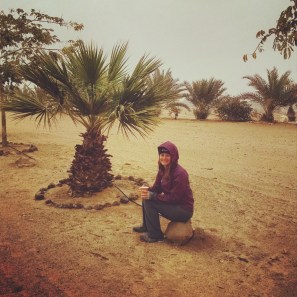 than I could have imagined and a variety of different palms. The weather is just chilly enough for the need to wear every layer of clothing I own. Instead of a fruit drink, I make a couple of cups of instant coffee to help warm up. Instead of waves crashing, yesterday the cold rain was beating on the roof which also means I have a hood pulled over my head instead of a floppy hat. The tan I acquired only a month or so earlier has nearly faded. No seagulls to speak of, just the sweet, resident yellow lab who stops in for a quick hello. And yet at the end of it all, He is still El Shama – God who hears. Not only did He hear, but He honored my request in full.


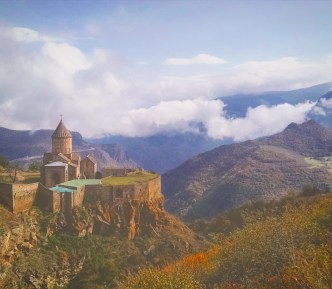 the monastery. Elements of the mill are still well preserved today. The buildings have undergone much destruction and reconstruction over the centuries due to invasions, natural disasters and even looters but the magnificence of this place still remains. It sits high on a cliff overlooking the gorge of the Vorotan River. Even though it is only used for tourism now, as I stood in the courtyard breathing in the structures on the property, I was able to imagine the hub of activity it once was. Tatev really is a sight to behold as she stands proud of her legacy like a castle in the clouds.


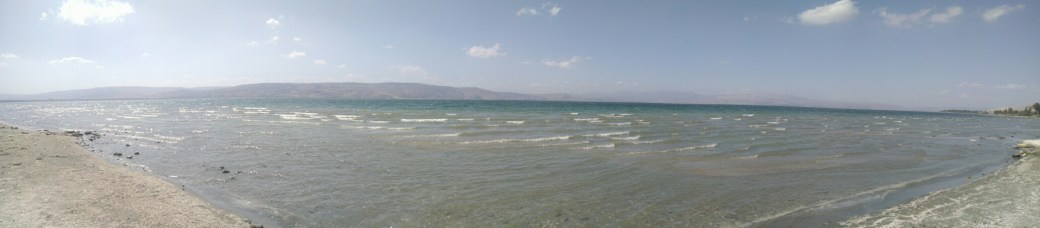
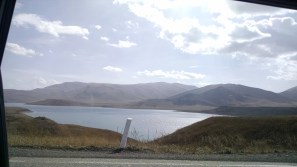 largest body of water in Armenia measuring twenty miles wide and over forty-five miles long. It is also one of the largest high-altitude lakes in Eurasia sitting at a whopping 6,234ft above sea level! And let me tell you, while you area driving next to it, it just keeps going and going and going. The lake is considered a “national treasure” by providing electricity, fish and tourism to Armenia’s economy. As with most areas of Armenia, the history of Lake Sevan can be traced further back than most Americans can fathom with proof in the old black monastery which is situated on a peninsula overlooking the water. Since Lake Sevan boasts the only beaches in Armenia, it is a popular vacation spot for Armenians during the warm months.


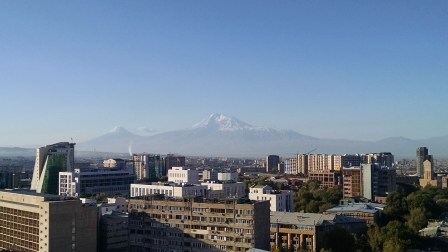
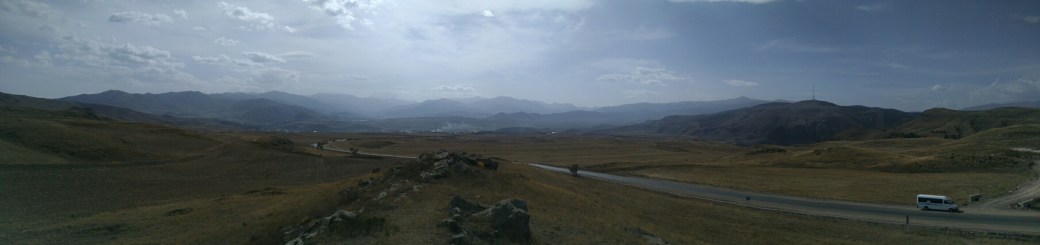
 hen we reached the small winery town of Areni, a nature preserve with a cave called to us so we turned off the main road and drove through the high cliffs and foliage. Truth be told, we never found the cave but an old monastery was waiting on top of a cliff area at the end of the preserve road.
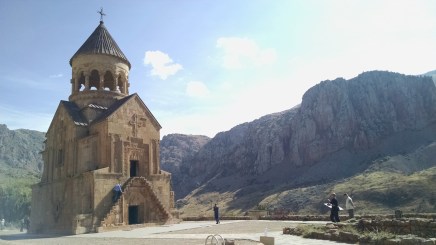 attraction and a physical reminder of what once was. Monasteries were used as places of worship as well as hospitality centers, providing overnight accommodations for travelers passing through. Perhaps they were considered the first hostels or guest houses. Monks lived on the premises ministering and taking care of guest needs. Notice: The stairs in the front, on the outside of the structure. This is not a common feature for Armenian monasteries.










 Tara's Treks